
Your best consultant just got staffed on a four-month project in a city she's never set foot in. She needs somewhere to land by Monday. So you make a quick call: extended stay hotel, or furnished apartment?
It feels like a small logistics question. Stretched over sixteen weeks, it's a several-thousand-dollar one, and it quietly decides whether she's rested and sharp or fried by week six.
So let's actually break it down. Extended stay hotels vs. furnished apartments:
- what each one is
- where each genuinely wins
- how to choose without overspending or wearing your people out
Difference Between Extended Stay Hotels vs. Furnished Apartments?
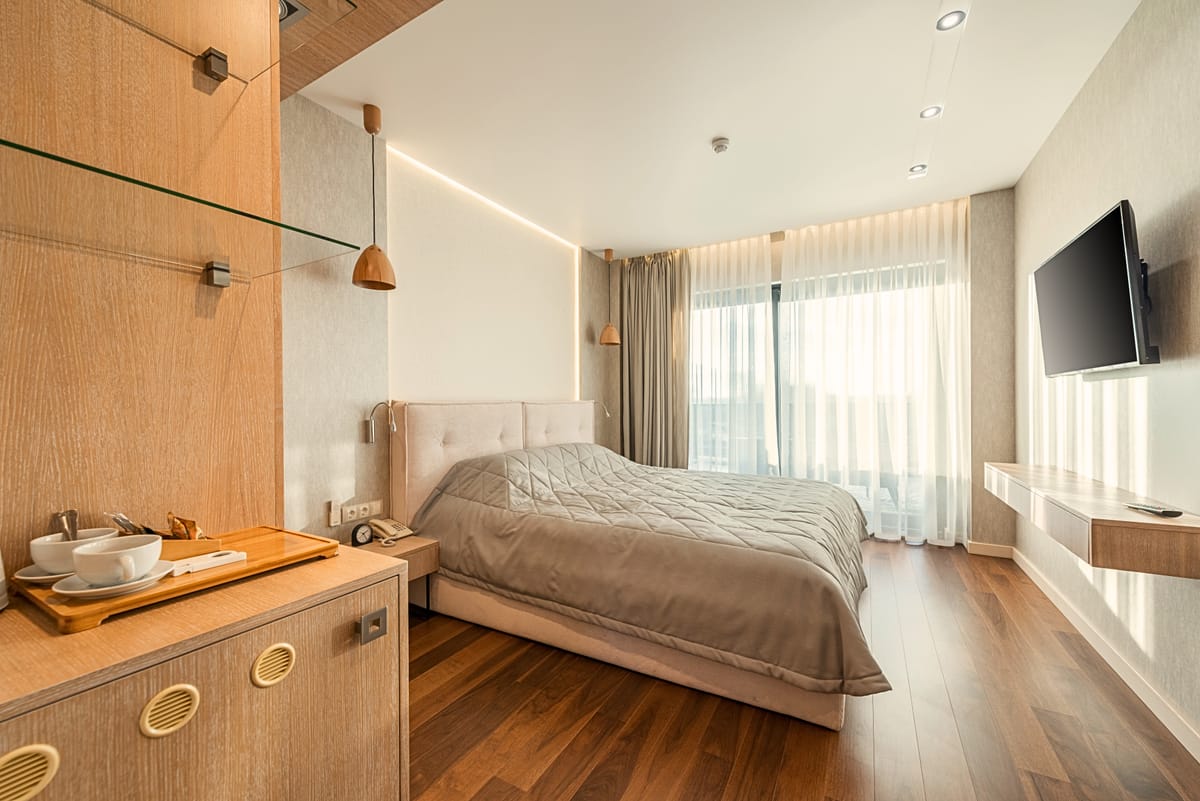
An extended stay hotel is a hotel built for longer visits. You get a room or suite with a kitchenette, weekly housekeeping, a front desk, and discounted weekly or monthly rates. No lease, move-in ready, and you can extend or check out with relative ease. Think WoodSpring Suites, Extended Stay America, or Residence Inn.
A furnished apartment, usually called corporate housing when a company is footing the bill, is a real, fully furnished home you rent by the month. Separate bedroom, full kitchen, in-unit laundry, a living room, with utilities and Wi-Fi rolled into a single rate. It's move-in ready like a hotel, but it lives like an apartment.
The short version: an extended stay hotel is a hotel that lets you stay longer. A furnished apartment is a home you don't have to furnish. That gap barely matters for a long weekend, and matters enormously once the stay runs past a couple of weeks.
Extended Stay Hotels vs. Furnished Apartments: At a Glance
The Cost Comparison is Where it Gets Interesting
At first glance, an extended stay hotel can look like the cheaper, simpler option: one nightly rate, everything bundled, nothing to set up. And for a short stay, that's often true. But nightly rates are built to look small and add up quietly.
Run the math on a longer stay, and the picture flips.
Hotels price by the night, so even a discounted monthly rate rarely competes with an all-inclusive furnished apartment on cost-per-square-foot. Then there's the part nobody puts on the booking page: the hidden cost of no kitchen.
A kitchenette with a microwave and two burners isn't a kitchen. On a 90-day assignment, that means eating out three times a day; easily $60–$80 daily in most U.S. cities, or several thousand dollars over the stay.
One more wrinkle that favours furnished apartments: in many places, stays over 30 days are exempt from hospitality and occupancy taxes, while hotel nights usually aren't.
Add it up, and it results in a lower effective rate, no restaurant bill, no daily tax, and the tipping point where a furnished apartment becomes the smarter buy tends to land somewhere around the two-week mark.
Space, Workspace, and Actually Getting Work Done
When your accommodation doubles as your office for a few weeks, square footage stops being a luxury and becomes a productivity input.
An extended stay hotel room asks you to work, eat, sleep, and take calls in one combined space, often with a small desk and Wi-Fi shared across the whole building.
A furnished apartment gives you a separate bedroom where 7 a.m. calls don't happen three feet from an unmade bed, a living room to decompress in, a real desk, and increasingly private, higher-speed internet that holds up on video.
For anyone running back-to-back meetings or managing a distributed team, that's the difference between a space that works with them and one that grinds them down. As we've written before, reliability is the real luxury in long-term stays.
Flexibility, Leases, and Move-In
This is where extended stay hotels earn their keep. Both options skip the traditional lease and land you somewhere move-in ready, but hotels edge ahead on pure flexibility: you can often book a room for tonight, and cancel or extend with little penalty. Furnished apartments and corporate housing usually want a handful of days' lead time and a minimum stay (often 30 days).
So if the timeline is genuinely uncertain in those first few weeks, or someone needs a bed in under 48 hours, an extended stay hotel is the safer bet. If the stay is defined and long, that flexibility premium is money spent on an option you won't use.
Privacy, Consistency, and Duty of Care
Extended stay hotels mean shared hallways, a rotating cast of guests, and daily foot traffic. A furnished apartment gives you the whole place to yourself every time, with quieter, more private, more stable living over a long stint.
For companies, there's a bigger point buried here: duty of care. When you place an employee somewhere for months, you're responsible for their safety and wellbeing. Professionally managed corporate housing is vetted to consistent quality and safety standards, which is far easier to stand behind than a room whose only guarantee is a brand logo. It's the same reason more travel and mobility teams have moved past both hotels and Airbnb for longer assignments.
Living Like a Local, Not a Guest
Extended stay hotels cluster near highways, airports, and commercial strips. Furnished apartments sit in actual neighbourhoods near the grocery store, the coffee shop, the park, and, when it matters, decent schools.
For a relocating family or an employee three months into an assignment, that residential normalcy does a lot of quiet work. You end up knowing the city you're living in, not just the road between the office and the lobby.
So Who Should Book What?
The honest answer is that neither option wins across the board. It depends on the trip.
An extended stay hotel is the better call when:
- The stay is short; a few days to two or three weeks.
- The timeline is genuinely uncertain in the near term.
- Someone needs housing in under 48 hours.
- You're in a small secondary market where furnished apartment supply is thin.
- It's a solo traveller who mostly needs a clean, reliable place to sleep.
A furnished apartment wins when:
- The stay is 30 days or longer.
- It's a relocation, a project deployment, or an extended assignment.
- The person is working from "home" all day and needs space to perform and recover.
- You're housing a team and want them near each other, or a family that needs room and routine.
- Predictable, all-inclusive billing and a single invoice make life easier for finance.
A Quick Decision Framework
If you like rules of thumb: under two weeks, book the extended stay hotel. Two to four weeks is a grey zone; let the person's needs and the certainty of the timeline decide.
Thirty days or more, book the furnished apartment almost every time. The longer and more work-heavy the stay, the more decisively the math and the comfort tip toward a real home.
How to Vet a Furnished Apartment Provider
Not all furnished apartments are created equal; some premium operators own and manage their inventory, while budget intermediaries simply relist Airbnb units with a corporate label. Before you book a long-term stay, ask:
- Is the pricing genuinely all-inclusive: electricity, water, gas, internet, parking?
- What's the minimum term and the notice period?
- Is the Wi-Fi private to the unit, or shared building access?
- Does the provider control the inventory, or resell someone else's?
- What happens when something breaks mid-stay? Who fixes it, and how fast?
- Is it one consolidated invoice, or a pile of receipts to reconcile?
Those six questions separate a real housing partner from an aggregator in about five minutes, and they map neatly onto everything a mobility or travel team is accountable for.
The Nearsite Take
For short, uncertain trips, extended stay hotels still earn their place. But for the assignments that define a mobility program- the relocations, the multi-month projects, the teams shipped to one city furnished apartments win on cost, space, and the simple fact that a rested employee does better work.
The usual catch is sourcing: hunting through listings, guessing whether the Wi-Fi is real, and reconciling a mess of invoices.
That's the gap Nearsite closes.
We source vetted, genuinely work-ready homes with transparent, all-inclusive pricing, then handle booking and management on one AI-powered platform: one invoice, full visibility, no coin flips. So your people walk in, drop their bags, and are online before morning.
Ready to make long-term stays simpler for your whole team?
See how Nearsite can house your people →
Frequently Asked Questions
- Are furnished apartments cheaper than extended stay hotels?
For stays of 30 days or more, usually yes. Once you factor in a full kitchen (fewer restaurant meals), all-inclusive billing, and the tax exemption many markets apply past 30 days, furnished apartments typically come in cheaper than a comparable extended stay hotel, often meaningfully so.
- How long should a stay be to justify a furnished apartment?
Roughly two weeks is the tipping point. Beyond that, the cost, space, and comfort advantages stack up quickly; past 30 days, a furnished apartment is almost always the stronger choice.
- Can you live in an extended stay hotel long term?
Yes. Extended stay hotels are designed for weeks or months at a time, with kitchenettes, laundry, and discounted monthly rates. It's practical for shorter or uncertain stays; it just gets pricier and more cramped the longer you stay.
- Do furnished apartments include utilities and Wi-Fi?
With a good provider, yes. Reputable corporate housing bundles electricity, water, gas, internet, and furnishings into one monthly rate, so there's nothing to set up and one predictable bill to approve.
- How much notice do you need to book corporate housing?
In most major markets, a few business days to about a week. For zero-notice arrivals, housing needed in under 48 hours, an extended-stay hotel is often the more realistic option.